
by
Brunno Ribeiro
/
How are office relationships working in the era of remote jobs?
Love in the Time of Zoom: How Remote Work is Redefining Office Romance
Remote Work
Office Culture
Workplace Romance
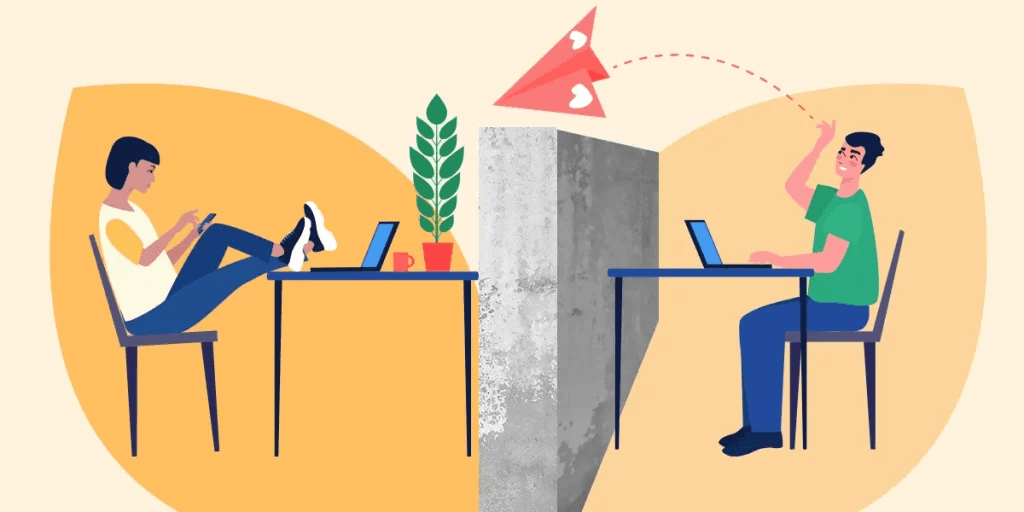
In the modern landscape of professional engagement, the dynamics of workplace romance have encountered a transformation, especially in the wake of the remote work revolution.
Historically, office romances were commonplace, chronicled in the plots of sitcoms and celebrated in stories of couples who met during work hours.
Before the pandemic dramatically reshaped the landscape of remote work, workplace romances had been a blend of allure and caution.
Company policies have constantly regulated such relationships, especially when involving leaders and their subordinates, in order to maintain a transparent and unbiased work environment.
Over the past few years, the traditional avenues for arousing such relationships have been through a substantial shift.
A poll conducted by Monster asked over 5,100 individuals: “Do you think dating a colleague would harm your career prospects and would you do it?”
Here are the responses provided by over 5,100 surveyed individuals published on their website:
39% said dating a workmate would be harmful for their career and they would never date a colleague.
27% said dating a workmate wouldn’t be harmful for their career and that they would date a colleague.
19% agreed that dating a colleague could potentially harm their career, but they would do it if there was mutual attraction.
15% of respondents don’t think it’s harmful. Still they would never date a colleague.
The poll showed a prevalence of employees attracted to the idea. Still, a significant portion remained apprehensive due to potential career ramifications.
The sudden shift to widespread remote work during global lockdowns disrupted the traditional narrative surrounding office romances.
While physical distancing limited face-to-face interactions, it also gave rise to a surge in the use of dating apps and virtual communication tools.
Platforms like Microsoft Teams and Zoom became the new conduits for social connections, bridging the gap imposed by isolation and fostering virtual relationships.
Another interesting survey, this time conducted by ResumeBuilder.com with 1,250 Americans, unveiled that amid remote work settings, one-third of respondents initiated romantic relationships, which in turn highlights the human inclination towards companionship even in remote workspaces.
However, the study also shed light on the darker side, revealing instances of sexual harassment, emphasising the need for robust company cultures and HR policies to safeguard against such misconduct.
Remote work, deprived of the traditional office environment, presented challenges for promising romances. The absence of physical proximity and reduced face-to-face interactions altered the landscape, making it less likely for spontaneous connections to develop. Yet, experts note a shift towards alternative means of building relationships, such as increased flirtation via texts, emails, and online platforms.
As workplaces gradually navigate the return to in-person settings, speculation arises regarding the resurgence of office romances. While the physical reconnection might fuel a renewed interest in personal interactions, the flexible work models adopted by many organisations might foster new opportunities for blossoming relationships.
Professionals foresee an emergence of innovative ways to connect, from business trips to shared outdoor activities, fostering a blend of personal and professional spheres.
However, this evolution also poses potential challenges, including increased harassment risks and blurred boundaries between work and personal life.
Companies will need to adapt their policies to accommodate these changes, ensuring a conducive environment while recognising the natural human inclination towards connection and companionship.
When all is said and done, whereas the landscape of workplace romance has undoubtedly evolved in the era of remote work, the inherent desire for human connection persists.
The blend of digital communication and returning in-person interactions may redefine the narrative, presenting both opportunities and challenges in navigating relationships within the evolving professional landscape.